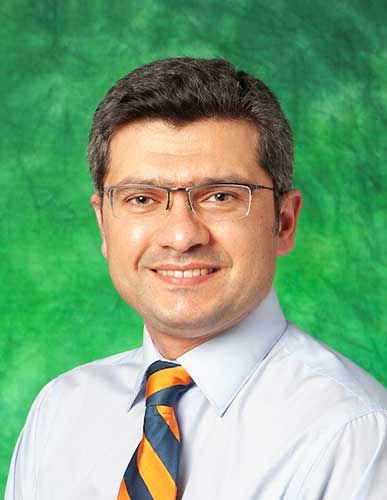
- SelcukAcarProfessorEducational PsychologyFacultyselcuk.acar@unt.edu940-565-4646
 Matthews Hall 316Google ScholarFacultyEducational PsychologyTabs
Tab Style
Tab Shown on Load
1
Heading
Content
About
Selcuk Acar, Ph.D., is a Professor of Educational Psychology at the University of North Texas. He earned his Ph.D. in Educational Psychology, with an emphasis in Gifted and Creative Education, from the University of Georgia. His research centers on divergent thinking, creativity assessment, and the education of gifted and talented students. Prior to joining UNT, he worked at the Torrance Center for Creativity and Talent Development at the University of Georgia and the Center for Applied Imagination at SUNY Buffalo State. Dr. Acar has authored numerous book chapters and encyclopedia entries and has published more than 85 peer-reviewed articles, primarily in creativity research. He previously served as Principal Investigator on a creativity measurement grant funded by the Institute of Education Sciences to develop a new measure of original thinking (MOTES). He is currently co-leading a National Science Foundation–funded project focused on human–AI collaboration for creativity development. He serves as Co-Editor of Psychology of Aesthetics, Creativity, and the Arts and serves on the editorial boards of Gifted Child Quarterly, Journal of Creative Behavior, Journal of Advanced Academics, and Creativity Research Journal. Dr. Acar is the recipient of the American Psychological Association Division 10 2022 Berlyne Award for outstanding research by an early-career scholar and the University of Georgia’s 2026 Alumni Award in the Mid-Career Researcher category.
Publications
Acar, S., Lee, L.E., &Scherer, R. (2024). A reliability generalization of the Torrance Tests of Creative Thinking-Figural. European Journal of Psychological Assessment. Advance online publication. https://doi.org/10.1027/1015-5759/a000819
Acar, S., Dumas, D., Organisciak, P., &Berthiaume, K. (2024). Measuring original thinking in elementary school: Development and validation of a computational psychometric approach. Journal of Educational Psychology. Advance online publication. https://dx.doi.org/10.1037/edu0000844
Bower, J., Acar, S., Kursuncu, U. (2023). Measuring creativity in academic writing: An analysis of essays in Advanced Placement Language and Composition. Journal of Advanced Academics, 34(3-4), 183-214. https://doi.org/10.1177/1932202X231211633
Organisciak, P., Acar, S., Dumas, D., and Berthiaume, K. (2023). Beyond semantic distance: Automated scoring of divergent thinking greatly improves with large language models. Thinking Skills and Creativity, 49, 101356. https://doi.org/10.1016/j.tsc.2023.101356
Acar, S. (2023). Does the task structure impact the fluency confound in divergent thinking? An investigation with TTCT-Figural. Creativity Research Journal, 35(1), 1-14.
Acar, S., Tadik, H., Uysal, R., Myers, D., &Inetas, B. (2023). Creativity and socioeconomic status: A meta-analytic review. Journal of Creative Behavior, 57(1), 138-172. https://doi.org/10.1002/jocb.568
Acar, S., Ogurlu, U., &Zorychta, A. (2023). Exploration of discriminant validity in divergent thinking tasks: A meta-analysis. Psychology of Aesthetics, Creativity and the Arts, 17(6), 705-724. https://doi.org/10.1037/aca0000469
Acar, S., Branch, M. D., Burnett, C., &Cabra, J. (2021). Assessing the universality of the zero originality lists of the Torrance Tests of Creative Thinking (TTCT) - Figural: An examination with African American college students? Gifted Child Quarterly. Advance online publication. https://doi.org/10.1177/00169862211012964
Acar, S., Neumayer, M., &Burnett, C. (2021) Social media use and creativity: Exploring the influences on ideational behavior and creative activity and accomplishment. Journal of Creative Behavior, 55(1), 39-52. https://doi.org/10.1002/jocb.432
Acar, S., Tadik, H., van der Sman, C., Myers, D., &Uysal, R. (2020). Creativity and wellbeing: A meta-analytic review. The Journal of Creative Behavior. Advance online publication. http://dx.doi.org/10.1002/jocb.485
About
Selcuk Acar, Ph.D., is a Professor of Educational Psychology at the University of North Texas. He earned his Ph.D. in Educational Psychology, with an emphasis in Gifted and Creative Education, from the University of Georgia. His research centers on divergent thinking, creativity assessment, and the education of gifted and talented students. Prior to joining UNT, he worked at the Torrance Center for Creativity and Talent Development at the University of Georgia and the Center for Applied Imagination at SUNY Buffalo State. Dr. Acar has authored numerous book chapters and encyclopedia entries and has published more than 85 peer-reviewed articles, primarily in creativity research. He previously served as Principal Investigator on a creativity measurement grant funded by the Institute of Education Sciences to develop a new measure of original thinking (MOTES). He is currently co-leading a National Science Foundation–funded project focused on human–AI collaboration for creativity development. He serves as Co-Editor of Psychology of Aesthetics, Creativity, and the Arts and serves on the editorial boards of Gifted Child Quarterly, Journal of Creative Behavior, Journal of Advanced Academics, and Creativity Research Journal. Dr. Acar is the recipient of the American Psychological Association Division 10 2022 Berlyne Award for outstanding research by an early-career scholar and the University of Georgia’s 2026 Alumni Award in the Mid-Career Researcher category.
Education
2013, The University of Georgia, Ph.D. in Educational Psychology2007, Istanbul University, M.A. in Gifted Education2004, Bogazici University, B.A. in Educational Sciences
Research & Publications
Creativity
Creativity measurement
Divergent thinking
Meta-analysis
Gifted education
Google Scholar